
If you run an e-commerce store, you probably spend a lot of time and resources on traffic acquisition: SEO, ad campaigns, social media, email marketing. But there is one area that is often overlooked and can have an enormous impact on revenue: the quality of your internal search.
The data is unambiguous: users who use the search bar convert significantly more than those who browse by category alone. Investing in search is not an expense: it is the highest-ROI optimisation. Discover the 5 must-have search features for your online store and why they make a difference available to most online stores.
The Data: Why Internal Search Is Your Best Salesperson
According to data from the Baymard Institute, users who use an e-commerce store's internal search have an average conversion rate of 4.63%, compared to 2.49% for users who do not. This means searchers convert at nearly double the rate.
But the data becomes even more interesting when we consider the context:
- Search users typically represent 25-35% of total traffic on an e-commerce site.
- These users often generate 40-50% of total revenue, a disproportionate share relative to their numbers.
- The average order value (AOV) of search users is generally 15-25% higher than that of non-search users.
The reason is intuitive: people who use search already know what they want. They have a clear purchasing intent. If the search works and takes them to the right product, the conversion is almost guaranteed. If it does not work, that customer leaves — often for a competitor.
The Search Conversion Funnel
To understand where to intervene, it is useful to analyse the conversion funnel specific to internal search:
- Discovery: the user arrives at your site (from Google, an ad, a direct link).
- Search: the user types a query in the search bar.
- Results: the search engine returns a results page.
- Click: the user clicks on a product from the results page.
- Purchase: the user adds the product to their cart and completes the order.
How AI improves each step of the funnel
An AI search engine improves every single step of this funnel:
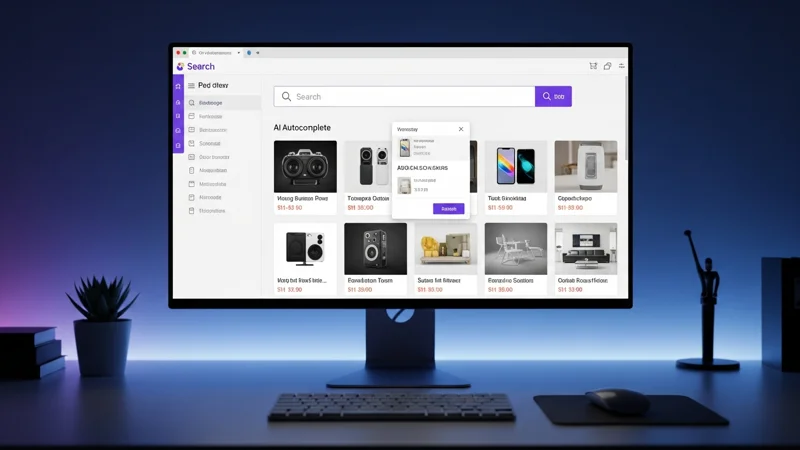
- Autocomplete (between discovery and search): reduces friction and guides the user toward effective queries.
- NLP and typo tolerance (in the search phase): ensures every query returns relevant results, even with errors.
- Intelligent ranking (in the results phase): places the most relevant products at the top, reducing search time.
- Product previews (in the click phase): shows image and price directly in suggestions, speeding up the decision.
- Related suggestions (in the purchase phase): proposes complementary products, increasing cart value.
ROI Calculation: A Concrete Example
Let us do a practical calculation to understand the economic impact. Consider an e-commerce store with these characteristics:
- 10,000 unique visitors per month
- 30% use internal search = 3,000 searches/month
- Current search conversion rate: 2%
- Average order value: 80 euros
Current situation:
3,000 searches x 2% conversion = 60 orders/month = 4,800 euros/month from search
With an AI search engine (5% conversion):
3,000 searches x 5% conversion = 150 orders/month = 12,000 euros/month from search
Difference: +7,200 euros/month, or +86,400 euros/year.
Even a more modest improvement — from 2% to 3.5% — would generate 45 additional orders per month, equal to 3,600 euros in additional monthly revenue. With the typical cost of an AI search engine between 29 and 79 euros per month, the ROI is extraordinary.
Of course, these numbers are simplified. The actual improvement depends on many factors: catalogue quality, industry, customer profile. But the principle holds: even small improvements in search conversion rate translate into significant revenue.
5 Quick Strategies to Optimise Search Conversion
Beyond choosing a good search engine, there are actions you can take right away to improve performance:
1. Make the search bar visible and accessible
It sounds obvious, but many stores hide the search behind a small icon. The search bar should be clearly visible, preferably at the top of every page, with placeholder text that invites searching (e.g., "Search over 5,000 products...").
2. Optimise product titles and descriptions
The search engine can only find what exists in the data. If your titles are generic ("Product XYZ"), the search will struggle to return relevant results. Use descriptive titles that include key attributes: colour, material, size, brand.
3. Monitor and act on zero-result queries
Regularly check the queries that return zero results. Often, a few synonyms or redirects are enough to recover dozens of lost sales each week.
4. Customise ranking for strategic products
If you have products with higher margins, active promotions, or new arrivals, use your search engine's merchandising features to promote them in relevant results.
5. Analyse and iterate constantly
Search is not a "set and forget" project. Check analytics at least once a week, test new synonyms, update redirects, and measure the impact of every change on the conversion rate.
The Most Underrated Investment in E-Commerce
In our experience, internal search is the most underrated area of e-commerce optimisation. Merchants invest thousands of euros in advertising to bring visitors to their site, only to greet them with a search that cannot find the products they are looking for.
It is like spending a fortune to attract customers to a physical store and then having no staff able to help them. The traffic is there, the purchase intent is there, but the connection between supply and demand breaks down.
An AI search engine restores that connection. For an overview of the 10 best practices that maximize search ROI, read our complete guide to ecommerce search optimization. If you want to understand how to choose the right AI search engine for your store, we have prepared a dedicated guide. The numbers prove it, the ROI calculation confirms it, and implementation is now simpler than ever. If there is one single investment you can make to improve your e-commerce performance, internal search offers the highest return and the lowest risk.
Frequently Asked Questions
Users who use internal search convert 2-3x more than those who only browse categories. An AI search engine can further boost conversion rates through more relevant and personalized results.
Compare the additional revenue generated by improved search (conversion increase × average order value × number of searches) with the service cost. The return is typically visible within the first month.
Yes, even with few products, AI search improves user experience through typo tolerance, synonyms, and autocomplete, reducing zero-result searches.