The way customers search for products online is changing rapidly. Expectations are set by everyday experiences with search engines like Google: your customers expect instant, relevant, and intelligent results in your online store as well.
In 2026, having internal search that "just works" is no longer enough. Stores that invest in advanced search features see a direct impact on conversions, average order value, and customer retention. Here are the five features we consider essential this year.
1. AI-Powered Relevance Ranking
The first and most important evolution from traditional search is the shift from keyword matching to intelligent ranking. As we explain in our article on how AI search boosts conversions. An AI-powered search engine does not just find products that contain the query words: it orders them by their actual relevance to the user.
How it works in practice
The algorithm considers multiple factors:
- Semantic relevance: the engine understands that "white sneakers" and "white sports shoes" refer to the same type of product.
- Popularity: best-selling or most-clicked products are promoted in results.
- Availability: out-of-stock products are demoted or hidden automatically.
- Personalisation: in advanced systems, ranking accounts for the user's previous behaviour.
The result is a search experience that closely resembles an expert shop assistant who knows the store and understands what the customer is looking for.
2. Typo Tolerance and Synonym Understanding
We have already discussed the importance of typo tolerance, but in 2026 it is no longer a "nice to have" feature: it is a minimum requirement. Data shows that up to 25% of mobile search queries contain at least one typo.
Beyond typo tolerance
Typo tolerance alone is not enough. A modern search engine must also handle:
- Synonyms: "sofa" and "couch", "laptop" and "notebook", "t-shirt" and "tee".
- Linguistic variations: plurals, verb forms, common abbreviations.
- Hybrid queries: mixes of languages, such as "black iPhone cover" or "men's running sneakers".
The key is that all of this should work automatically, without the merchant having to manually configure every synonym or rule. The best systems learn from catalogue data and user behaviour.
3. Smart Autocomplete with Product Previews
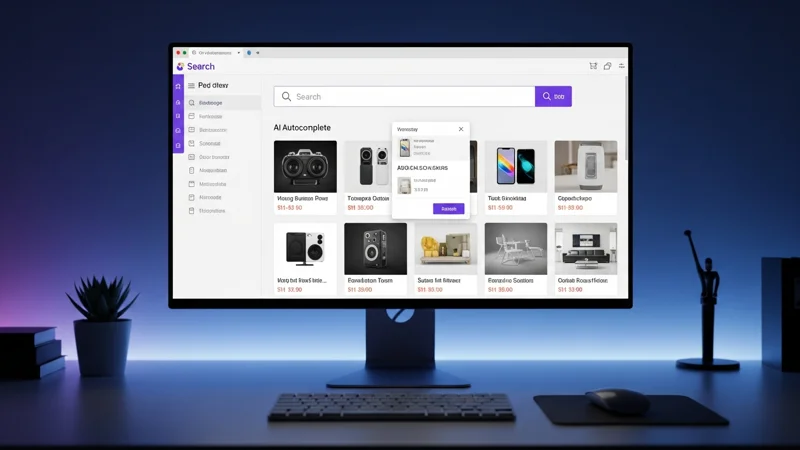
Autocomplete is the feature with the most immediate impact on user experience. When the user starts typing, they should immediately see:
- Query suggestions: completions based on the most popular searches.
- Product suggestions: specific products with image, price, and availability, visible directly in the search dropdown.
- Category suggestions: "Are you looking in the Running Shoes category?"
Autocomplete reduces search time by up to 40% and significantly increases the click-through rate, because the user sees their desired product before they even finish typing the query.
Speed: the critical factor
Suggestions must appear in real time, ideally within 100 milliseconds of each character typed. Any visible delay renders autocomplete useless.
4. Search Analytics Dashboard
In 2026, a search engine without analytics is like a physical store without a cash register: it works, but you do not know what is happening.
Key metrics to monitor
A dedicated analytics dashboard gives you visibility into:
- Most frequent queries: what are your customers searching for? This information is invaluable for merchandising, catalogue management, and purchasing planning.
- Zero-result queries: the single most important metric. Every search with no results is a potential customer who cannot find what they want. It may indicate missing products, unconfigured synonyms, or indexing issues.
- Conversion rate by query: which searches lead to purchases? Which do not? This lets you optimise product pages and descriptions.
- Temporal trends: how do searches change over time? You can anticipate seasonal demand and prepare your catalogue accordingly.
The best search engines also offer suggested actions: for example, "The query 'sunscreen' had 500 searches and zero results this week. Would you like to add a synonym or redirect?"
5. Multilingual and Multi-Market Support
European e-commerce is inherently multilingual. Even a store that only sells in one country may have customers searching in English, German, or French. A modern search engine must:
- Natively support the main European languages, with language-specific rules for each (lemmatisation, synonyms, stop words).
- Handle multilingual catalogues: the same product may have a title and description in different languages, and the search must index them all.
- Adapt to context: if the site is in Italian, the search should prioritise Italian content while still being able to find results for queries in other languages.
Market segmentation
For stores selling in multiple countries, it is essential that the search engine supports market segmentation: different prices, different availability, and different catalogues for each market, all managed from a single dashboard.
Bonus: Emerging Trends
Beyond the five core features, two emerging trends are worth watching as they gain traction in 2026:
- Visual search: the ability to search for products by uploading a photo. Particularly relevant for fashion, furniture, and design, where describing a product in words is often difficult.
- Voice search: with the spread of voice assistants and smart speakers, more and more users expect to be able to search for products by speaking. Search engines that support voice queries will have a growing competitive advantage.
These technologies are still in the adoption phase, but stores that start preparing today will be the first to benefit tomorrow.
Conclusion
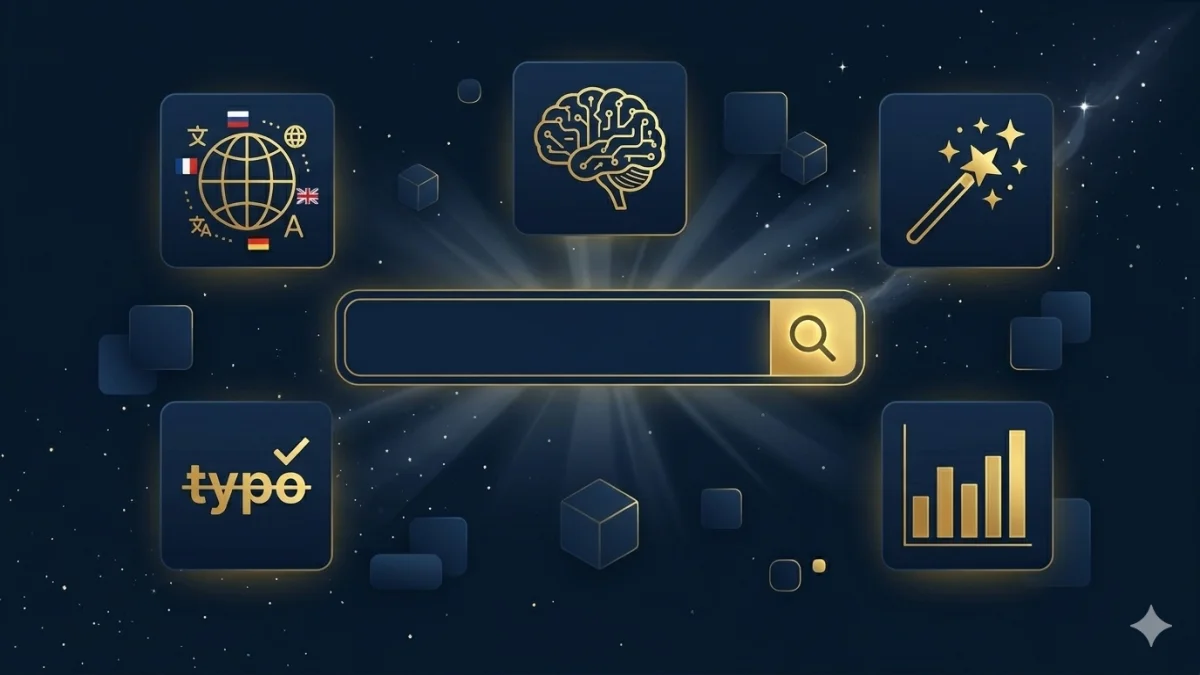
The five features we have described — AI ranking, typo tolerance, smart autocomplete, analytics, and multilingual support — are no longer optional. They are the minimum required to deliver a search experience that meets the expectations of 2026 consumers.
If your current search engine does not offer all five of these features, it is time to evaluate alternatives. For a complete roadmap on how to improve every aspect of search, check out our complete guide to ecommerce search optimization. Check our guide to choosing an AI search engine for a detailed comparison. The cost of ineffective search is not just in sales lost today but in customers who will not return tomorrow.
Frequently Asked Questions
The five must-have features are: AI-powered ranking, typo tolerance, smart autocomplete, search analytics, and multilingual support.
About 20-30% of searches contain typos. Without typo tolerance, these searches return zero results, causing abandonment and lost sales.
AI ranking analyzes user behavior, product relevance, and search context to order results in a way that maximizes purchase probability.